
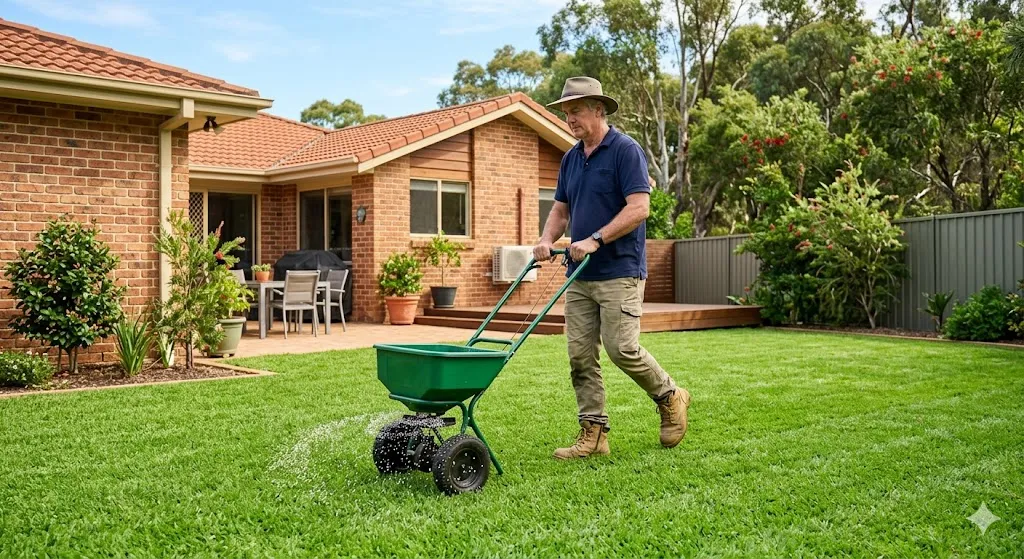
Fertilising at the wrong time wastes money and can burn your lawn. Fertilising at the right time transforms it. Here is exactly when to apply fertiliser in Sydney, by season and grass type.
The Golden Rule of Lawn Fertilising
Only fertilise when your grass is actively growing. Applying fertiliser to dormant grass does nothing except feed weeds. In Sydney, your main growing seasons are spring (September-November) and autumn (March-May). Summer can work with caution. Winter — do not fertilise at all.
Related: seasonal lawn care · Sir Walter Buffalo care · lawn care guide
Season-by-Season Fertiliser Schedule
Spring (September to November)
This is your most important feed. After winter dormancy, your lawn is hungry. Apply a nitrogen-rich slow-release fertiliser in early September once you see consistent new growth. A second light application in late October if you have Buffalo or Kikuyu. What to use: High-nitrogen formula — look for an N-P-K ratio like 20-5-10.
Summer (December to February)
Proceed with caution. If your lawn is healthy and well-watered, a light feed in early December can sustain growth through the holidays. But if there is a heatwave or water restrictions, skip it — fertilising stressed grass causes burn. What to use: A balanced slow-release formula, half the spring rate.
Autumn (March to May)
This is your second critical feed. A potassium-rich fertiliser in March strengthens roots and cell walls, preparing your lawn for winter. Stronger roots mean faster green-up in spring. What to use: High-potassium formula — look for higher K number, like 10-5-20.
Winter (June to August)
Do not fertilise. Your lawn is semi-dormant. Fertiliser will wash away unused and feed winter weeds instead.
Fertiliser by Grass Type
| Grass Type | Best Fertiliser | Frequency |
|---|---|---|
| Buffalo | Slow-release, moderate nitrogen | 2-3 times/year |
| Kikuyu | High nitrogen, fast release OK | 3-4 times/year |
| Couch | Frequent light feeds, balanced NPK | 4+ times/year |
Signs Your Lawn Needs Fertiliser
Fertilising works best as part of a full seasonal plan. See our seasonal lawn care guide for what else your lawn needs throughout the year. Not sure what grass you have? Our grass types comparison will help.
- Yellowing or pale green colour
- Slow growth during growing season
- Thinning or bare patches appearing
- Weeds taking over (they thrive in underfed lawns)
At Grass Blades, fertilising is available as an add-on to your regular mowing service. We apply the right product at the right time — you do not need to remember what to apply when.